



Leadership consistency depends on self-knowledge (“…know thyself!”).
As we move from personal integration into leadership practice, a new question emerges:
Why are some leaders consistent under pressure — while others become unpredictable? The answer is not usually intelligence. Nor is it experience. More often, it comes down to self-knowledge.
If leadership begins on the inside (Part 2.1), and direction must be interiorly claimed before it can be executed (Part 2.2), then consistency requires that a leader understand how he or she is wired.
This is where temperament not only comes into play, but becomes essential.
What Is Temperament?
For thousands of years, thinkers have observed that human beings tend to exhibit consistent patterns of reaction. Classical philosophy described four primary temperaments:
- Choleric – decisive, strong-willed, action-oriented
- Melancholic – analytical, reflective, detail-oriented
- Sanguine – relational, enthusiastic, expressive
- Phlegmatic – calm, steady, harmonious
Each temperament has characteristic strengths and predictable weaknesses. Each interprets stress differently. Each brings a distinct energy into a room.
Temperament is not a modern personality trend. It is an ancient framework for understanding human behavior.
And it is not the same as character. The difference:
- Temperament is largely biological. It shapes your first inward reaction.
- Character is formed. It shapes your chosen outward response.
That distinction is critical for leaders.
Temperament Explains Human “Friction”
Many human conflicts are not moral failures — they are most often unexamined temperamental differences:
- A choleric leader may push hard for results and unintentionally overwhelm a more reflective team member.
- A melancholic leader may delay action in pursuit of perfection.
- A sanguine leader may overcommit because enthusiasm outruns capacity.
- A phlegmatic leader may avoid necessary confrontation in order to preserve peace.
None of these tendencies are defects. They are strengths without formation.
Every temperament casts a shadow. And under stress, that shadow becomes visible.
The Temperament Table (included here) outlines the natural tendencies, strengths, and “challenge habits” associated with each type. It is not meant to label leaders. It is meant to increase awareness.
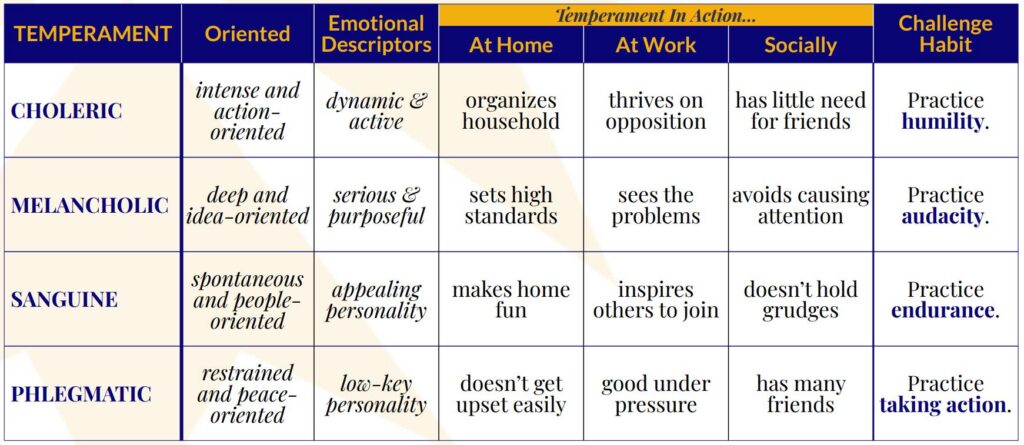
Awareness reduces friction. Awareness clarifies patterns. Awareness restores responsibility.
Character Determines Follow-Through
So, where does this leave us?
- Temperament explains your impulse.
- Character determines your leadership.
And Virtue, properly understood, is not moral decoration. It is practical strength. It is the intentional, cultivated habit that reigns in your temperament and strengthens your reliability:
- A decisive (choleric) leader must cultivate humility.
- A reflective (melancholic) leader must cultivate courage (“audacity”).
- An enthusiastic (sanguine) leader must cultivate discipline (“endurance”).
- A steady (phlegmatic) leader must cultivate initiative (“taking action”).
THIS IS HOW SELF-KNOWLEDGE BECOMES FORMATION!
And this is why leadership consistency depends on more than mission clarity or strategic alignment. It depends on interior formation translating into disciplined action.
Teams do not need leaders who are intense. They need leaders who are reliable.
When temperament is understood and character is strengthened, follow-through improves. Judgment stabilizes. Friction decreases. Trust increases.
This is the bridge from personal integration to leadership practice.
If you have never intentionally reflected on your temperament, that is a wise place to begin. The Temperament Quiz is not about boxing yourself into a category. It is about identifying where growth is needed so that your leadership becomes steadier, clearer, and more consistent.
Because integration is not just about knowing who you are.
It is about becoming dependable for others.
START BUILDING THE BRIDGE – LEARN YOUR OWN TEMPERAMENT HERE.