

YOUR PATH TO GREATNESS
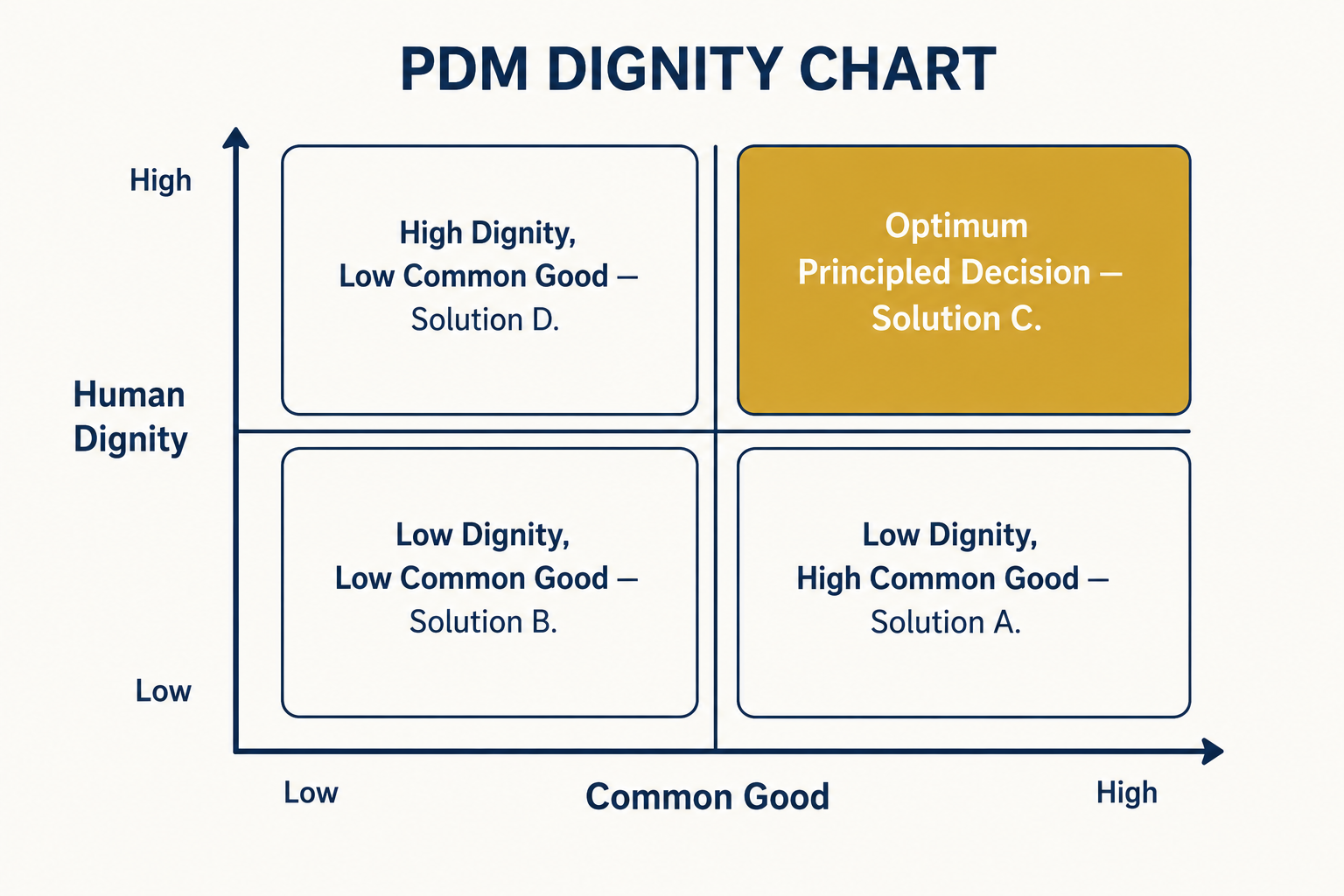
The optimum principled decision lives where dignity and the common good intersect.
Truth: The optimum principled decision lives where human dignity and the common good intersect. It’s the hardest quadrant to reach — and the only one without regrets.
Every decision you make lands somewhere on a chart you’ve never drawn.
The vertical axis is human dignity — does this decision treat every person as a “who,” not a “what”? The horizontal axis is the common good — does it create conditions where everyone affected can flourish?
Most decisions cluster in the lower-left. Not because leaders are bad people — because default forces (urgency, profit, politics, fear) pull everything downward and to the left.
The upper-right quadrant is where dignity and the common good both score high. It’s the optimum principled decision — the choice that honors the full humanity of every stakeholder while serving conditions for everyone’s flourishing.
It’s also the hardest quadrant to reach. Not because good options don’t exist there. But because upper-right solutions require you to see stakeholders you’d rather ignore, generate options you haven’t considered, and sometimes sacrifice margin for something the spreadsheet can’t measure.
Mark Rios’s Solution C lived in the upper-right. It wasn’t the most profitable option. It wasn’t the fastest. But it was the one that let every person in the equation keep their dignity — including Mark.
Here’s what I’ve learned: once you make a decision that lives there, you never forget what it feels like. Not euphoria. Something quieter. Peace. The kind that doesn’t require explanation or defense.
The lower-left has its own feeling too. You know the one.
This week: Think about the last significant decision you made. If you had to place it on the chart — dignity on one axis, common good on the other — where would it land? Don’t judge it. Just place it.
YOUR PATH TO GREATNESS
○○○○○○○○○○○○○○○○○○○○○○○○○○○○○○○○