

YOUR PATH TO GREATNESS
For every problem, there are at least four paths. Most leaders only see two.
Truth: For every problem, there are at least four paths. Most leaders only see two. The principled leader finds the one that honors both dignity and the common good.
Here’s what most decision-making looks like: Option A or Option B. Yes or no. Take the deal or walk away.
Binary thinking is fast. It’s also usually wrong — because it assumes the only choices are the ones already on the table.
Mark Rios had two obvious options with the gray contract. Option A: sign it as written. Option B: reject it entirely. His team saw A and B. It felt like a coin flip between profit and principle.
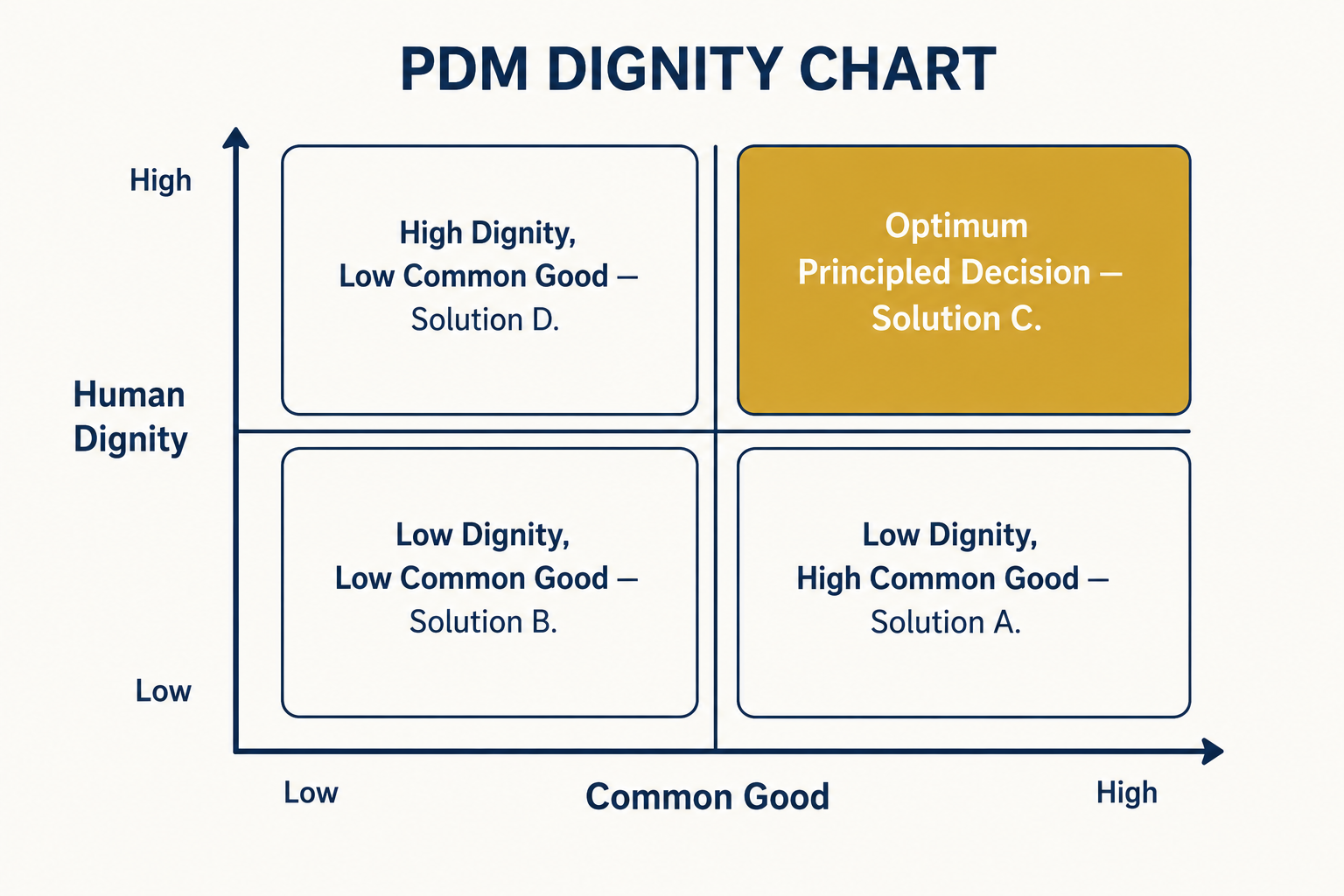
But principled decision-making doesn’t accept the binary. PDM Step 3 says: define at least four potential solutions. Not two. Four. Because somewhere between “take it” and “leave it” live the solutions that honor both dignity and the common good.
Mark found Solution C: renegotiate the risk-sharing clause so the subcontractor wasn’t absorbing disproportionate downside. Lower margin, same client, clean conscience.
And Solution D: restructure the deal entirely as a joint venture, sharing both risk and upside.
The magic of four solutions is that it forces creativity where binary thinking produces paralysis. A or B feels like a trap. A, B, C, or D feels like a landscape.
Most of the decisions that keep you up at night are binary traps. The principled decision is almost never A or B. It’s C — the option you haven’t thought of yet, because you stopped looking after two.
This week: Take a decision you’ve been framing as “either/or.” Force yourself to generate two more options — C and D. They don’t have to be perfect. They just have to exist. Notice how the decision changes when it stops being a coin flip.
YOUR PATH TO GREATNESS
○○○○○○○○○○○○○○○○○○○○○○○○○○○○○○○○