



There is a subtle but consequential mistake many leaders make—especially capable ones.
They focus first on execution:
- How do we perform better?
- How do we improve outcomes?
- How do we gain traction on the mission in front of us?
These are important questions. But they are not questions of effectiveness—they are questions of efficiency.
Efficiency is about doing things well. Effectiveness is about doing the right things.
And without interior direction, leaders often become highly efficient at pursuing aims they have never fully claimed. Direction must come first.
Every mission—personal or organizational—requires more than external agreement. It requires interior assent. Leaders may understand a mission intellectually, support it organizationally, and even communicate it persuasively—yet still struggle to embody it if they have not inwardly claimed it as their own. Meaning, they haven’t reconciled how executing their organizational mission helps them execute their personal one.
Organizational leaders often inherit missions they did not originate. They steward legacies, traditions, charisms, and cultures shaped long before they arrived. In such contexts, it is easy to confuse role fidelity with vocational clarity.
But they are not the same.
A role defines responsibilities; a vocation orders identity.
When leaders operate primarily from role, effectiveness becomes conditional. Energy rises and falls with external affirmation, institutional pressure, or immediate results. Leadership becomes performative—competent, even admirable, but inwardly strained.
When leaders operate from vocation, effectiveness becomes coherent.
Vocation answers the deeper question: Why am I here? Not merely in this job, but in this season of responsibility. It clarifies what must be protected, what can be sacrificed, and what must never be compromised—even when outcomes are uncertain or costly.
This interior claiming of direction changes how leadership is exercised.
Decisions become steadier because they are not driven solely by urgency. Tradeoffs become intelligible because they are measured against purpose, not pressure. Even difficult constraints are navigated with greater peace because the leader knows what they are ultimately aiming toward.
Direction does not eliminate tension—but it gives tension meaning.
Without direction, leaders may become highly efficient at achieving outcomes that slowly drift away from an institution’s deepest purpose. With direction, effectiveness serves something larger than metrics. It becomes an expression of alignment rather than output.
This is why interior clarity precedes execution.
You cannot effectively execute a mission you have not inwardly claimed. You cannot lead others toward a purpose you have not personally embraced. And no amount of technical competence can substitute for a leader who knows, at a deep level, where they are going—and why it matters.
Effectiveness is not the starting point of leadership. Direction is.
One Important Note
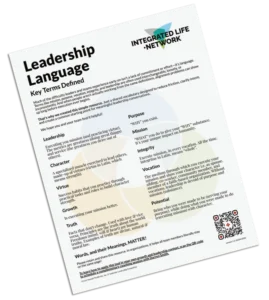 Much of the difficulty leaders and teams experience early on isn’t a lack of commitment or effort—it’s language. Terms like mission, purpose, vocation, integrity, and leadership are often used interchangeably, loosely, or inconsistently. And when people aren’t actually working from the same definitions, alignment problems can show up long before execution ever begins.
To help address that, we’ve made a simple, one-page Leadership Strength Training – Key Language Defined reference available as a free PDF. No opt-in. No funnel. Just a shared vocabulary designed to reduce friction, clarify intent, and create a common starting point for meaningful leadership conversations.
If it’s helpful to you—or to your team—you’re welcome to download it here.