


Human Dignity in an Age of AI
There is no doubt that AI is here to stay. And yet, how do we judge AI in the historical context we live in? It’s accelerating faster than any technology we’ve seen—by orders of magnitude. We might ask: is it like the internet? How long did that take? Or mobile computing? That also unfolded over many years. With AI, every month—or every six months—can feel like a decade compared to past technologies.
As business leaders, we need to understand AI and hold an informed opinion—personally, for our kids, and for our businesses.
I’ll begin with a recent moment in the Church. I was at home when the white smoke rose, and I listened for the name of the new Pope, Leo XIV. I immediately got texts from my brother and sister—my brother is a Catholic priest in the South Bronx. They understood—before the new Pope even appeared—that he had chosen the name Leo XIV in honor of Leo XIII. My father was a tremendous follower of Leo XIII and the encyclical Rerum Novarum, which addressed the first Industrial Revolution: the movement from country to city, the opening of factories, and the labor abuses and concerns of the late 1800s.
In his first address to the world, Pope Leo XIV essentially said: I chose the name Leo in continuity with Leo XIII, who addressed the social question in his time. Today, the Church offers her social teaching in response to another industrial revolution—developments in artificial intelligence that pose new challenges to human dignity, justice, and labor.
It’s striking that he’s focused on AI because it’s such a disruptor. He’s a mathematician, born and raised in the U.S., and I’ve heard he follows AI discussions daily—he wants to stay current. So today we’ll focus on human dignity, justice, and labor in the context of AI, and I’ll quickly walk through the four industrial revolutions—plus the emerging fifth—to place AI within the long arc of disruptive technology.
The First Industrial Revolution (c. 1760s–mid-1800s). Key innovations: mechanization powered by water and steam; textile machinery; steam locomotives; iron production; factories replacing artisanal and home-based work. This is early industrialization—no computing yet.
The Second Industrial Revolution (c. 1870–1914). We begin to see mass production and assembly lines—think Henry Ford; electrification; internal combustion engines; advances in steel and chemicals; telegraph and railways. This is the context in which Leo XIII wrote Rerum Novarum (1891): people moved into cities, unions formed, wealth disparities grew, and factory workers faced long hours and disruption to everyday life.
The Third Industrial Revolution (c. 1960s onward). Electronics, computers, and automation; programmable logic controllers (PLCs)—heavily used in oil and gas and industrial automation; IT systems, software, and the internet. Early AI thinking emerges here: symbolic logic, expert systems, basic decision-making, quality control, and process automation. (I led software in Honeywell’s automation division and worked closely with PLCs.)
The Fourth Industrial Revolution. Cyber-physical systems; the Internet of Things; sensors; data analysis; the beginnings of machine learning and real-time analytics; “smart factories” and autonomous decision-making. AI applications latch on here: predictive maintenance, autonomous robots, demand forecasting, real-time optimization, computer vision, and natural language processing—now integral to AI.
The Emerging Fifth Industrial Revolution
As this unfolds, we witness human-machine collaboration—“cobots” working alongside people. Humanoid robots are advancing quickly. I’ve been invited to speak this fall in Rome, leading a track at a conference of private equity and venture leaders, AI CEOs, church leaders, and ethicists. I’ll co-lead the session on humanoid robots with the head of robotics at MIT. The goal isn’t just discussion—it’s to craft guidelines for how the Church and other leaders should think about these topics.
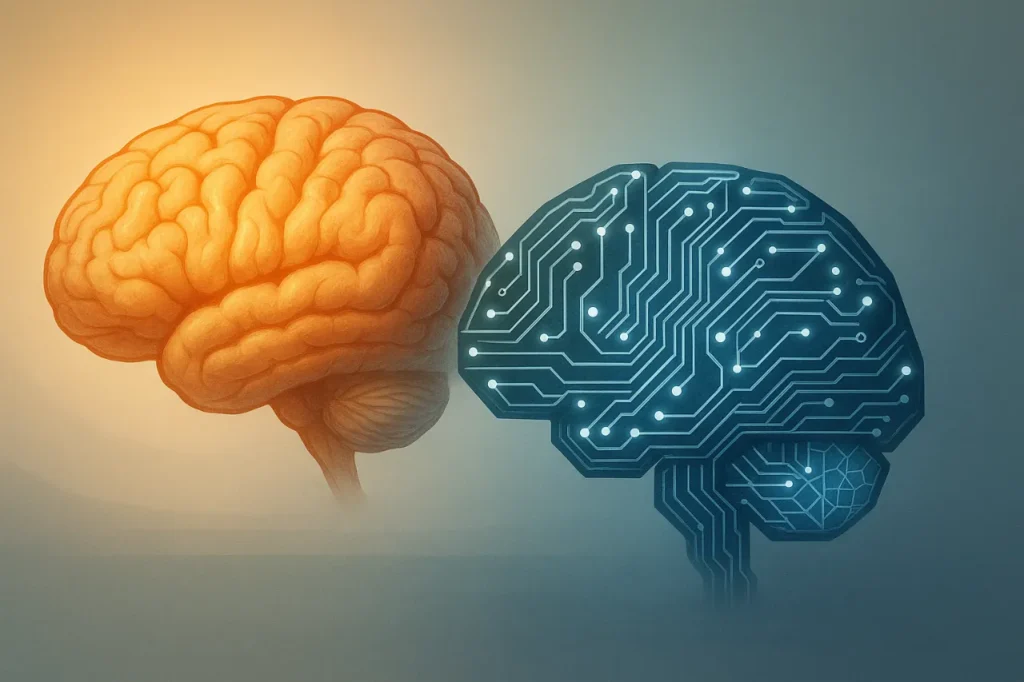
Other themes include personalization at scale (e.g., medicine, implants, custom products), ethical and responsible AI, and explainability—sources, reasoning paths, and bias. We’ve all heard about “hallucinations.” New “reasoning models” iterate in ways that mimic aspects of human thinking. Large language models self-organize in structures that suggest short-term and long-term memory and brain-like “lobes.” It’s a black box, but we can observe patterns. In a sense, it’s a reminder of the efficiency of the human mind—God’s design.
Where We Are Right Now
In the last 12–18 months, we’ve seen the public release of very capable models. OpenAI is on pace for extraordinary user numbers. Most usage is still individual—paid or free tiers—rather than deeply integrated into enterprise systems, though integration work is underway across finance, energy, and industrial sectors.
Capital is pouring in—hundreds of billions into AI and the supporting infrastructure. Much of the current data center build-out isn’t for training bigger models but to serve the exploding number of users. Token costs are falling, but token usage per interaction is rising as models do more computation to produce better answers.
The biggest bottleneck isn’t just chips or data centers—it’s electricity. Our current grid won’t support the projected growth. There’s plenty of money, but the constraint is power. Other countries, like China, are adding coal driven power generation rapidly; the environmental impact is global.
AGI and Beyond
You’ll hear more about AGI—artificial general intelligence—where AI matches human reasoning across most domains, not just specialized tasks. We’re not there. The Turing test is one way to benchmark indistinguishability across many interactions. ASI—artificial superintelligence—would exceed human capability broadly.
Skepticism is warranted: we humans program these systems, yet we’re surprised by the quality of some outputs. Part of that is the scope of data—AI can ingest every digitized word, which we can’t. It also increasingly handles analogy and nuance, which feels human-like.
Catholic Social Teaching and Work
Encyclicals like Rerum Novarum and, on its centenary, Centesimus Annus, update core understandings, as the nature of work evolves—from tangible, artisanal labor to knowledge work and the gig economy. The Catholic Church provides a moral compass for assessing AI’s impact on human dignity, justice, and labor.
AI is already disruptive: software roles have been reduced, creative tasks automated, brand work generated in seconds. But technology has always disrupted work. The key is adapting—how our children and grandchildren prepare. I wouldn’t recommend becoming a traditional computer programmer today unless you deeply understand what AI is doing in that field. Adjustments are necessary, because AI will continue to disrupt and transform our daily lives— everyone needs an informed perspective, based not only on technology, but on an understanding that every person has inherent human dignity.